
There is more reason for optimism than the futures market suggests.
 by Abigail Hoelscher, PCCA Chief Economist
If you judged the cotton market by price alone, you could easily conclude that not that much has changed. Prices remain well below the levels producers would like to see. Rallies have struggled to gain momentum. It would be easy to assume cotton is facing the same challenges it has for the past several years, but that’s no longer the whole story.
Behind today’s prices, the cotton market is steadily becoming healthier. Demand is improving. Global supplies are tightening. Cotton is becoming more competitive against polyester. Several long-term headwinds are beginning to turn into tailwinds. The futures market simply hasn’t given cotton much credit—yet. The reason has less to do with cotton and more with everything else happening in the world economy.
 A Market That Had to Work Through Excess Supply
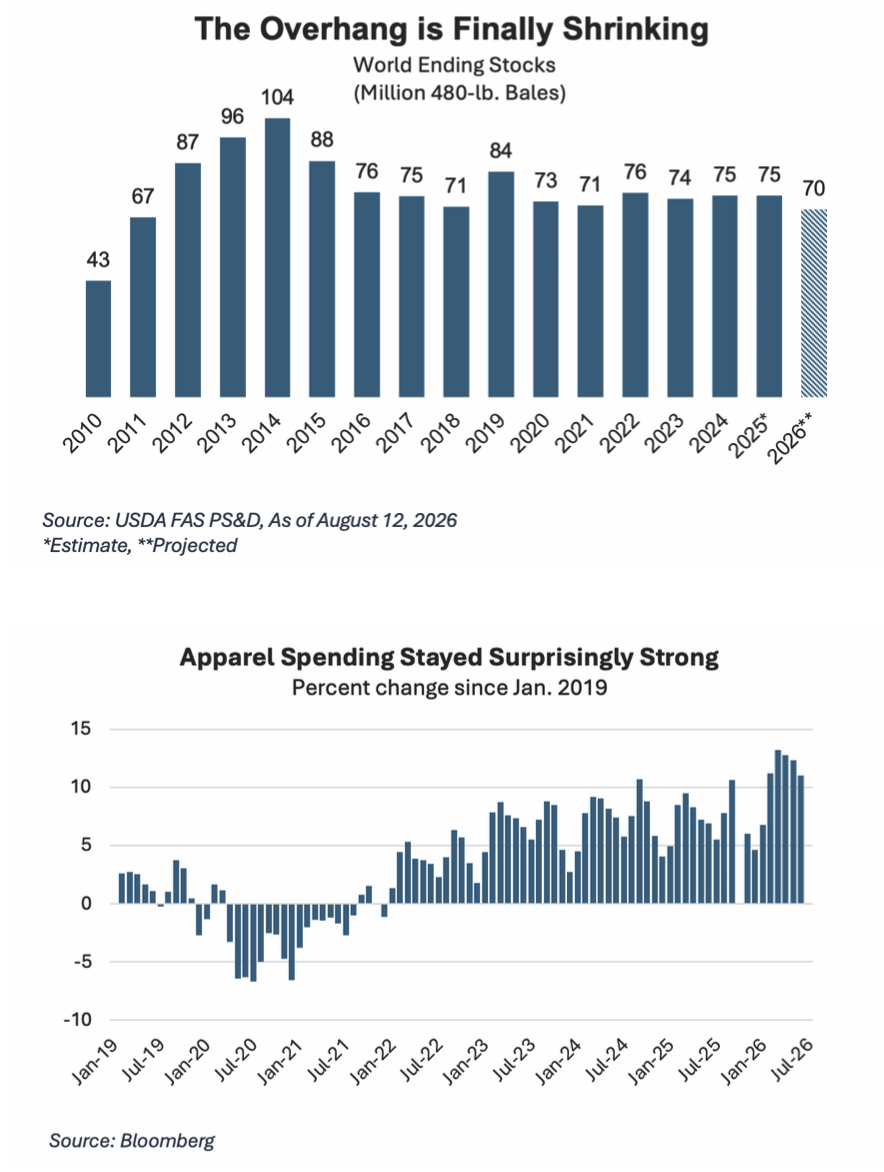
For several years, the world produced more cotton than it consumed. Each surplus crop added more cotton to warehouses around the world. Instead of starting each season with a clean slate, every new crop had to compete with millions of bales already sitting in storage. When supplies become that comfortable, buyers don’t feel pressure to act because they know cotton will be available tomorrow just as it is today.
Normally, low prices eventually solve that problem. Farmers plant fewer acres, production declines, and the market gradually rebalances. That adjustment took longer than expected.
Many growers outside the United States continued planting cotton because favorable currency exchange rates helped offset lower world prices. U.S. growers reduced acreage, but other major producing countries largely did not. The result was another year of production outpacing demand.
Demand wasn’t helping much either—not because consumers stopped buying clothes, but because every step of the supply chain had too much inventory. Retailers sold what was already on their shelves. Clothing brands delayed placing new orders. Textile mills bought less cotton because they were waiting on orders from their customers.
The supply chain essentially spent two years catching its breath, and now, that process appears to be largely behind us.
 The Story Is Changing
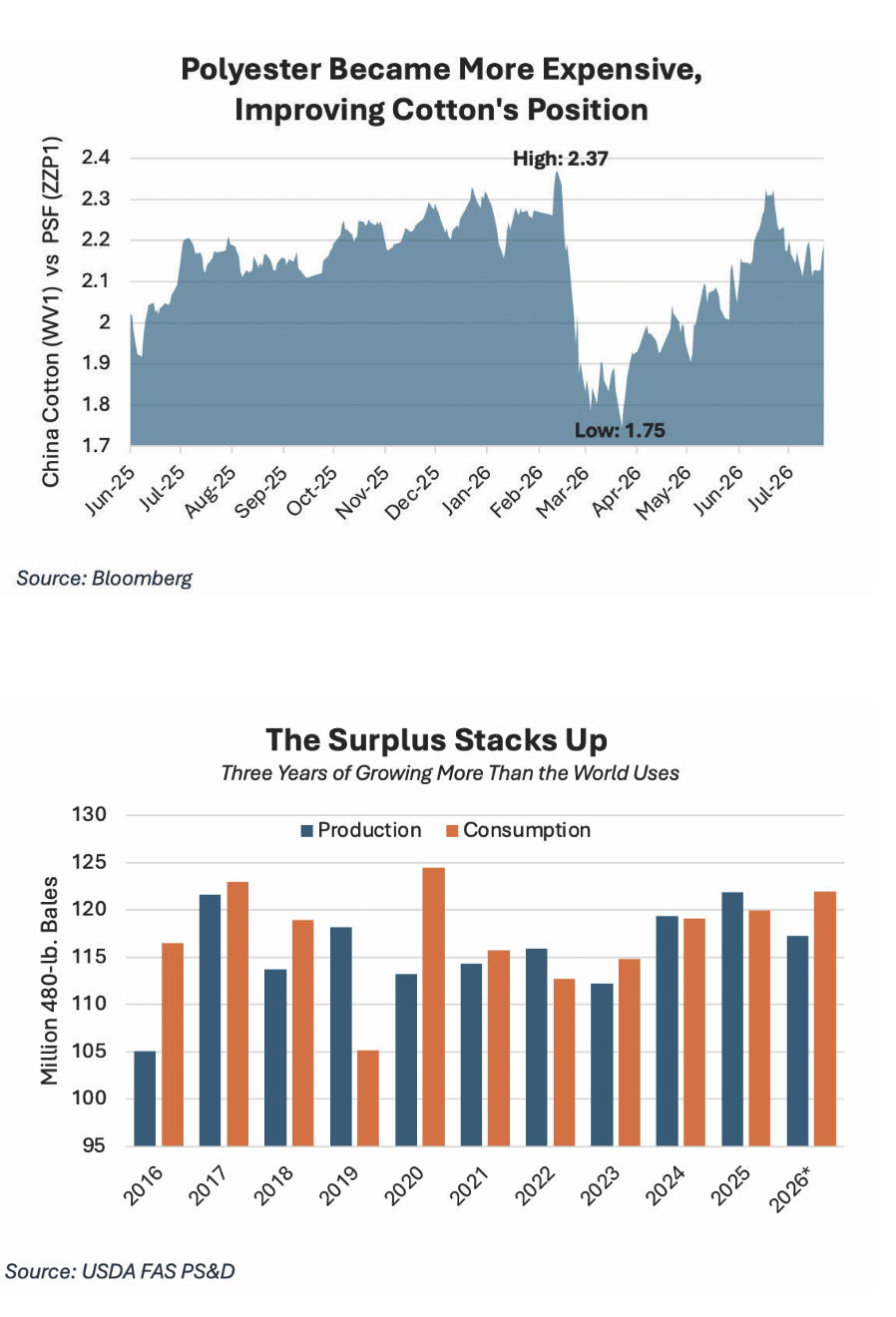
Several developments are beginning to move the market in the right direction. First, cotton has become more competitive with polyester. Higher energy prices have increased the cost of producing synthetic fibers. Since polyester is made from petroleum-based products, higher oil prices narrow the price advantage polyester has often enjoyed over cotton. That matters because even modest shifts toward cotton can translate into meaningful increases in world demand.
Second, the world’s cotton balance sheet is improving. The trend in USDA’s supply and demand forecast projects global cotton consumption will exceed production. If that happens, the world will begin drawing down inventories instead of adding to them for the first time in several seasons. That may be the single most important development in today’s market.
Commodity markets almost always become healthier when demand begins catching production, and cotton appears to be reaching that point.
Why the Market Hasn’t Noticed
If fundamentals are improving, why hasn’t the market responded? Because cotton isn’t trading on cotton alone. Today’s commodity markets are being driven by inflation, interest rates, energy prices, and geopolitical uncertainty. Large investment funds often move money into or out of commodities as an asset class rather than evaluating each commodity on its own merits. That means improving cotton fundamentals can be overshadowed by concerns that have nothing to do with cotton production or demand. It can be frustrating.
Good news doesn’t always immediately drive up prices. Sometimes the fundamentals improve first and prices catch up later.
Don’t Overlook China
China is another reason for cautious optimism. The country has been selling cotton from its government reserve, reducing its need for short-term imports. It’s a bearish move for today’s market, but reserves aren’t permanent. Early auctions sold out, which was a good sign. History shows that China eventually replenishes those stocks after selling them. Every bale leaving the reserve today is one that may eventually need to be replaced. In other words, the world’s largest cotton buyer hasn’t disappeared. Its purchases have simply been delayed.
Reasons for Optimism
No one should expect every challenge facing cotton to disappear overnight. Weather remains uncertain, economic growth could slow, and consumer spending always bears watching, but the list of positive developments is becoming longer than it has been in several years:
- Demand has strengthened.
- Global inventories are beginning to decline.
- Cotton is becoming more competitive with polyester.
- The world is expected to consume more cotton than it produces.
- China will eventually need to replace cotton leaving its reserve.
Those aren’t guarantees of higher prices. They are, however, the building blocks of a healthier market.
The Bottom Line
A year ago, it was difficult to build a bullish case for cotton. Today, that case is becoming much easier to make. The encouraging news is that the market’s fundamentals are improving even though futures prices have yet to fully reflect those changes. Eventually, markets have a way of returning to fundamentals.
When investors begin focusing on cotton again instead of the broader economy, they may discover a market that is considerably stronger than today’s prices suggest.