
Allan Fuchs | A&M Fuchs Farms
 by Blair White | Photos by Jordan Albus & Blair White
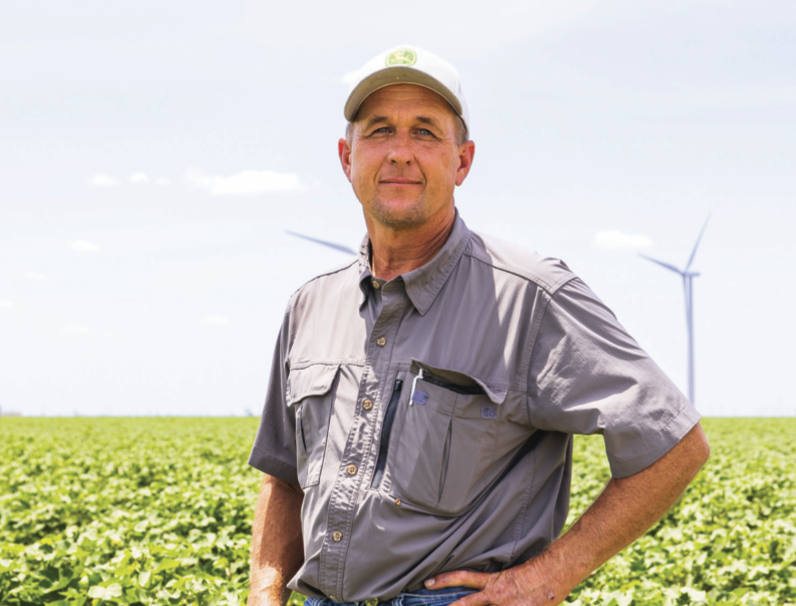
There are two commodities one can find plenty of in the Texas Permian Basin: cotton and oil. While cotton is still king on their operation, Allan Fuchs and his brother Michael of A&M Fuchs Farms in St. Lawrence, Texas, have started diversifying with another, less conventional crop — melons. Fuchs’ journey from cotton to melons is one of faith, opportunity, and, most importantly, the love of farming.
Deep Roots
Allan Fuchs grew up in West Texas and has had his boots in the sandy loam soil ever since. He was raised in a farming family, as were his wife and many of his childhood friends. In this part of the country, farming isn’t just a way of life— it’s the way of life.
“It’s really the only thing I’ve ever known,” Fuchs said. “My dad drove us out all the time from an early age. We were always involved on the farm.”
During his college years at Texas A&M, Fuchs realized urban living wasn’t for him. He remembers the moment he knew he had to get back to the farm.
“I was working for the crop testing program at A&M — I can remember it like it was yesterday,” Fuchs said. “I said, I cannot live here, I can’t be in town. I have to get back to the farm. I asked my dad, ‘Do you think we can make it work?’ He said, ‘I think you can make it work, but it’s going to be a challenge.’”
During Fuchs’ transition from college back home, his dad helped him find 400 acres to rent to get his operation running. He used row irrigation then and worked seven days a week, giving everything he had to keep the cotton growing.
“At that point, it was row irrigation. It wasn’t like I was coming back and participating in the family farm. I came back, and I was on my own, and that was what I had,” he explained. “I didn’t have any help and couldn’t afford help on 400 acres, just starting out. I look back, and it was sink or swim. Either get it, or don’t.”
By sheer determination and his nonstop work ethic, Allan saw a stand on his first crop in the early summer of 2000. It was a monumental achievement, but as is so often the case in agriculture, things changed quickly.
“I was helping my dad one morning, and he said, ‘Let’s go look at the farm.’ We did, and the cotton was beautiful,” Fuchs said. “We left, and there was a little thunderstorm popping up. Well, we didn’t even make it to the co-op gin on our way back, and it looked like it was raining over the field. We turned around and went back, and my crop was completely hailed out. So, 10 minutes after I saw it, it was gone. Man, what a way to start out.”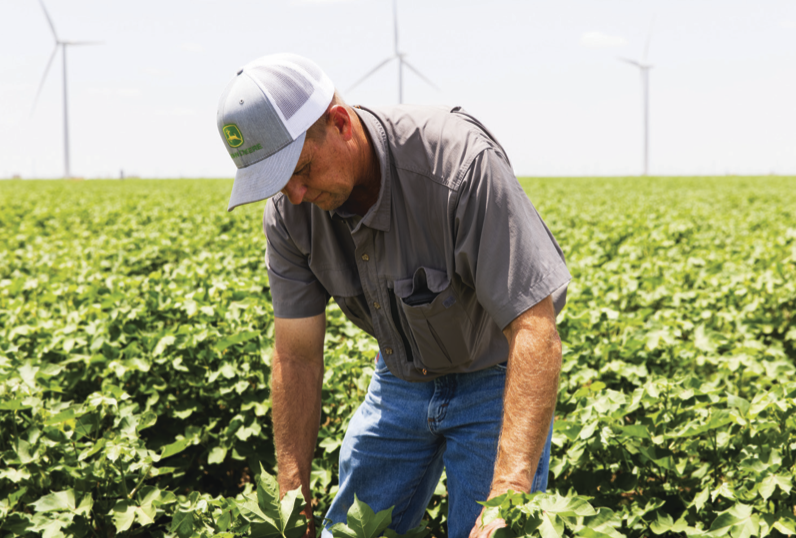
That sink-or-swim lesson, along with others, cultivated many important characteristics in Fuchs early in his farming career, chief among them the knowledge that cotton farming is not for the faint of heart. With that foundation, he began looking for ways to firm up his operation so that when trying times came, he could weather the storm.
Partnership and Diversification
Today, the Fuchs brothers’ operation is 80% in their partnership (on cotton and melons), and they have some separate acres as well. Of their total acres, 80% is dryland and 20% is irrigated. The two have found that their respective strengths complement each other and the different parts of the operation. Fuchs is a PCCA Delegate and member of the Marketing Pool Committee.
“We share labor, and we share equipment,” Fuchs said. “I move fast and do a lot of paperwork, and he’s [Michael] really great with mechanical stuff. We are two different people, and it really complements what we do. I can chew on him, and he can chew on me – we’re brothers, and we can be friends tomorrow.”
Cotton remains the brothers’ focus, but melons have added welcome diversification to farming in one of the hottest and driest parts of Texas. As their operation evolved, their irrigation methods evolved as well, allowing them to transition some fields with aging drip systems to melons.
“Where we have older drip systems and the water is more limited, that’s where we have transitioned to produce,” Fuchs said. “It’s really been the perfect fit for us.”
The Fuchs brothers first started farming melons in 2021, when a neighbor asked them to join their commercial melon venture. As they weighed the pros and cons of farming a new crop, Fuchs said he makes it a priority to take opportunities as they arise.
“This was just one of those opportunities that fell in our lap a little bit,” he said. “We were willing to take a risk, to chase it down and build it, and make it work.”
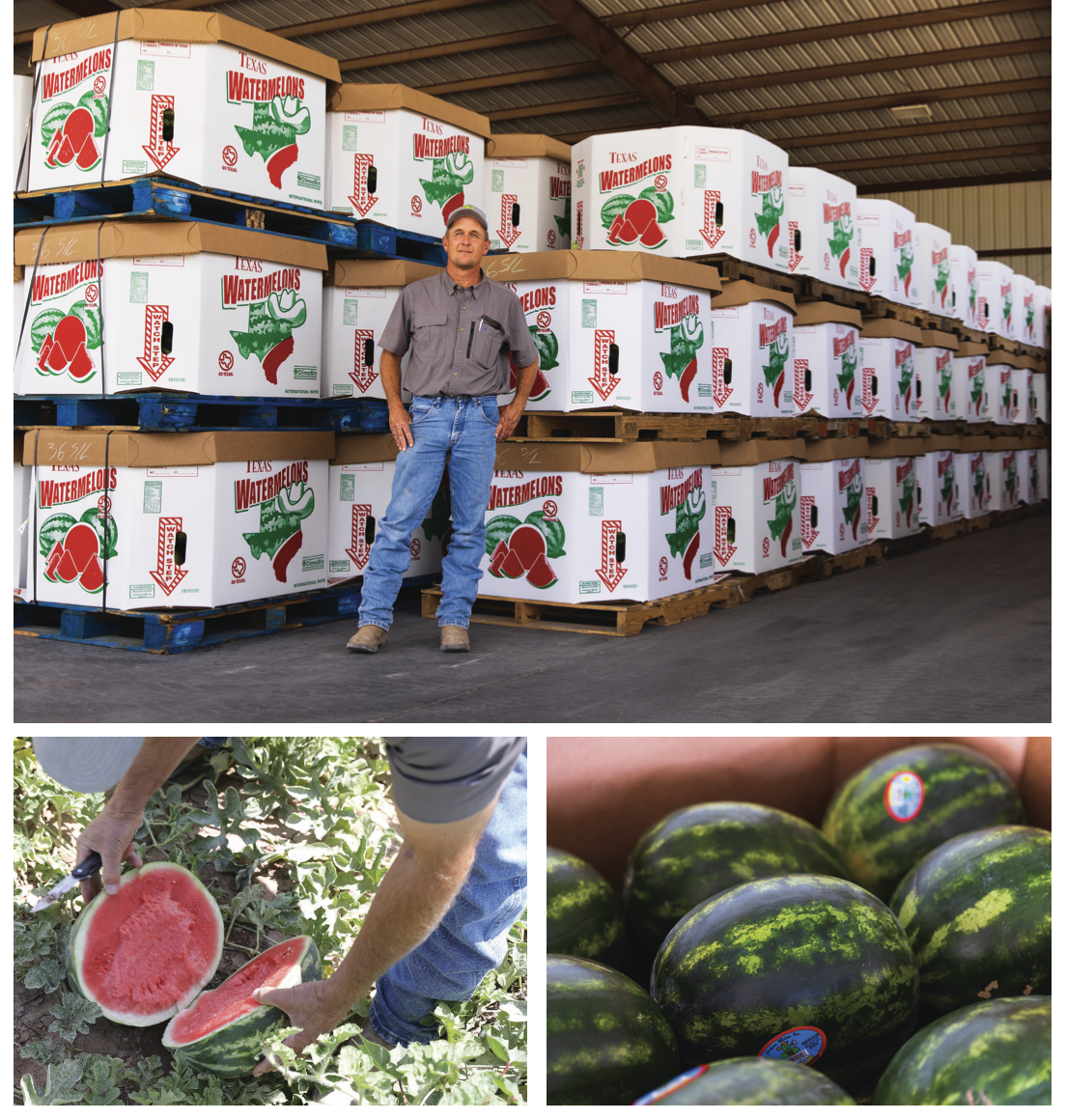
Starting out wasn’t as simple as throwing melon seeds in the ground, though. To be ready for harvest by July 1, the Fuchs brothers also had to build a packing shed, employee facilities, and plant and grow the crop. Allan and Michael had about six months to get everything up and running that first year.
“So we agreed. We started dirt work probably the first week in January, and by April, we were planting melons,” he said. “We got the facility up about a week before we were ready to start harvesting. We started out with 200 acres of melons, and now we are farming 400.”
While the first year was a bit tough due to the growing pains of a new crop and a new operation, the business’s success has paid dividends. That success matters even more because this melon operation has no insurance to claim.
 “There’s no safety net,” Fuchs said. “There is no insurance. It’s intense. It’s expensive to grow, and you have to make it work. If you don’t, there’s nobody to pick you up.”
Even so, Fuchs welcomes the adventure and risk of farming produce alongside his cotton, and that mindset carries into his day-to-day work.
“Farming can be a grind,” Fuchs expressed. “I think the produce side of it has been something new every day. There’s a problem every day, and it has to be solved now, and it’s been nice to have that in the mix.”
What started as a diversification opportunity has grown into an impactful operation. The melon operation currently employs 65 individuals, utilizing local hires and the H-2A program. The Fuchs are taking the opportunity they were blessed with and turning it into a blessing for other families whose lives also depend on agriculture. This reinforces an important principle: farming is about people.
For the Love of Farming
Throughout his farming career, Fuchs has met higher input costs, dropping groundwater tables, and shifting weather patterns with faith and tenacity. The uncertainty of making a living in agriculture has led him to focus on one goal for the future: ensuring the next generation is full of good people who are willing to work hard.
“Personally, it has never crossed my mind to leave a legacy,” he said. “I think my legacy is my family. You create good people who are good for this world, and that’s it. Raise a good family, and make good people, period.”
Fuchs knows that success in agriculture isn’t measured by money alone, but also by the people in one’s circle, the opportunities presented and risks taken, and the impact of seeing his work make a difference in someone else’s life.
“I think farmers love what they do,” he said. “They love providing their products to people. I love sending cotton and knowing it will become something someone will wear. I love going to the grocery store and seeing my label on a watermelon. I love it.”
For Allan Fuchs, that’s more than enough reason to keep farming.