aka “The Cotton Jassid”
by Rex Friesen, Ph. D., Southern Kansas Cotton Growers Cooperative, Anthony, Kansas
 News about the arrival and spread of the “two-spotted cotton leaf hopper”, or the “cotton jassid”, in the U.S., has been drawing a lot of attention over the last year or so…and rightfully so.
Many University and USDA researchers, entomologists, extension agents, etc., have devoted a lot of time and energy to the various facets of its biology, origins, distribution, control, etc., and many excellent presentations havealread y been given on its behalf. This is truly one bad insect that deserves to be taken very seriously! Dr. Ashleigh Faris, Extension Entomologist from OSU, stated that the cotton jassid “is a serious pest, perhaps the most threatening since the boll weevil.” From what I have seen and heard, I would tend to agree.
The cotton jassid is a small leafhopper of almost 1/8” long, with two distinctive black spots near the distal ends of the forewings. It originated on the Indian subcontinent, where it typically requires six to seven treatments per season, to avoid the potentially catastrophic yield losses, e.g., up to 90%, if left untreated (20%-40% are more typical). It has been detected in nearly 100 countries across Southern Asia, Africa, Europe, Oceania, and now North America. It was discovered in Puerto Rico in 2023 and in Florida in 2024, but by the end of the 2025 season, the jassid was found in 115 counties across nine US cotton-producing states, including 17 counties in Texas. The cotton jassid has a wide host range, e.g., over 25 species, including okra, hibiscus, eggplant (the Malvaceae family appears to be its favorite), and, to a lesser degree, peanuts, soybeans, corn, sorghum, and others. This fact may actually explain its arrival in Texas, e.g., riding on potted hothouse hibiscus plants imported from Florida. The damage symptoms of “hopper burn” are expressed similarly on other host plant species. Regardless of its origin, the jassid spread extensively over just one season, so we need to be carefully watching for it and know what to do if and when we find it.
The potentially significant yield impact from the cotton jassid is due to the combined effects of several factors: 1) jassids reproduce very quickly and can rapidly build into large populations; 2) a toxin in its saliva is injected into the leaf tissue when the jassid feeds on the sap; 3) the fast-acting toxin causes the fed-on leaves to turn off-color yellow, then red, and then brown (“hopperburn”) as they die and fall off within only a one- to two- week time period. Due to the rapid loss of photosynthetic capacity in affected plants, the detection and treatment of jassids must be prompt to avoid significant yield loss. The timing of when they show up during the season also affects their potential for damage–the later it is, the fewer the treatments that are necessary to get you “past the finish line”. Apotential complicating factor is that the symptoms on affected plants appear very similar to potassium deficiency, so accurate diagnosis is necessary to differentiate between the two so that appropriate measures can be taken.
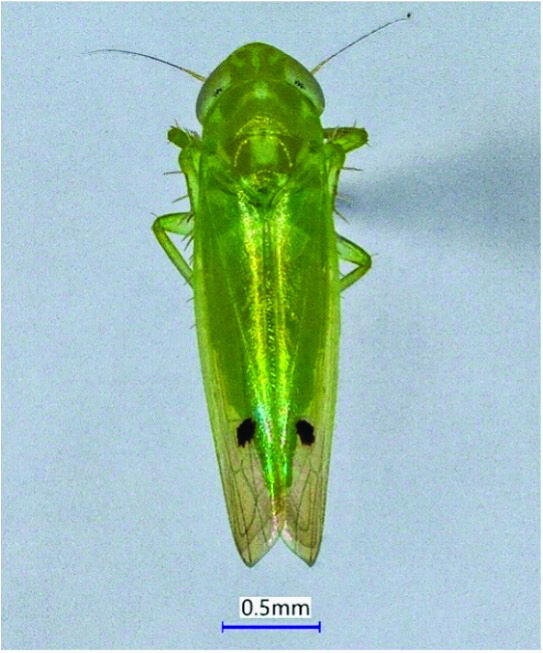
Adult Jassid. Photo by Isaac Esquivel,
University of Florida
The rapid (and impressive) response by a number of extension entomologists last year in several states where the jassid was discovered, has already provided us with much important information about the insect, e.g., its biology, how to recognize it and its damage symptoms, how to sample for it, and, most importantly, some ideas on how to manage it, such as treatment thresholds and the effectiveness of various insecticides in controlling it. The information database continues to grow and improve as more information comes in.
Although the cotton jassid was found in 115 counties by the end of 2025, the pressing question for 2026 is, “was it able to successfully overwinter and become established in the Cotton Belt?” Current information indicates that there is no dormant stage, e.g., eggs or diapausing (“sleeping”) nymphs or adults, to pass the winter, suggesting they require living host plants to feed on through the winter. This should help to dramatically reduce the size of their populations by the next spring, reduce their ability to become established, and limit their potential range if they do become established. Time will tell. At publishing time, only single individuals have been found in a few locations the U.S., and none on cotton thus far (as of June, 2026). This is very encouraging!
The absolutely most critical component of managing this pest is diligent scouting and prompt action, if and when, jassids are detected. Scouting fields is recommended at least once per week. Treatment thresholds were developed during the season last year, as researchers, consultants, and producers scrambled to control them. Experimental treatment thresholds dropped to lower and lower jassid numbers, until the final figure landed on only one jassid per plant plus the presence of any symptoms. In scouting for jassids, symptoms typically first appear on plants on the field edges, on “solo” plants, where plants exhibit discolored, yellowing, “cupped” leaves. If early symptoms are observed, sampling at least 25 leaves per field are recommended, looking at the underside of the fourth Main Stem leaf down from the top of the plant, which is the most likely location to find the jassids, if they are present. The ideal time to treat jassids is when there are minimal signs of damage, and before they spread across the field, however, whole field treatments are strongly recommended, regardless, and spot-treatments are discouraged. Advanced damage symptoms of reddening and or brown and desiccated leaves over increasingly larger areas can occur very quickly! As advanced symptoms proliferate, insecticide treatments may soon become ineffective – “too late” happens very quickly.
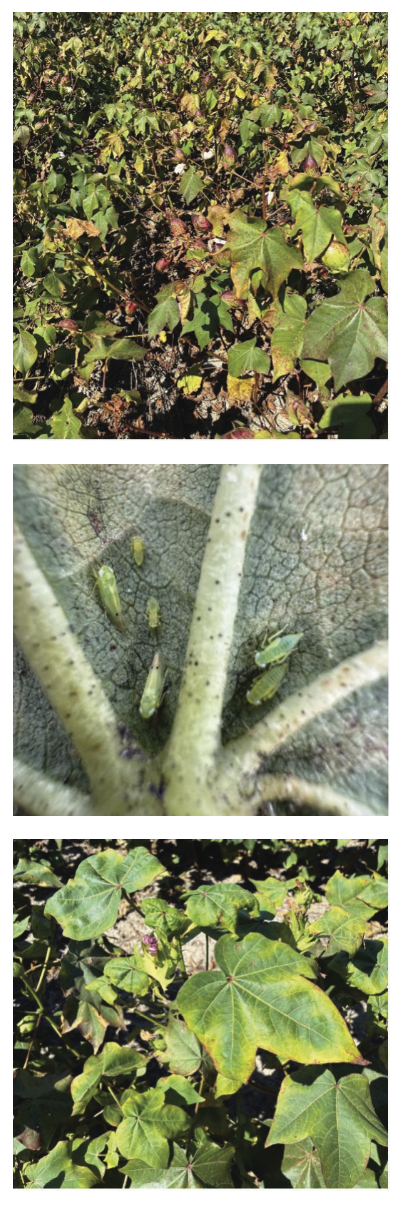
Top and Bottom: Jassid damage, courtesy of Bayer Crop Science. Center: Jassids on underside of leaf, courtesy of Alabama Cooperative Extension Service.
If treatment is justified, there are options that were found to be very effective. Multi-State insecticide evaluations of jassid control were conducted, and the results are important: none of the “traditional” chemistries of pyrethroids and organophosphates (except Bidrin) showed acceptable control. The most effective treatments in their trials were Venom, Vertento, Carbine, Bidrin and Argyl. Control may involve more than one treatment, which usually means it probably won’t be cheap. In 2025, most producers fighting jassid treated at least twice.
Besides chemical treatments, are there any other management practices that can reduce the impact of the jassids? Since insect populations build through the summer, management practices that promote crop earliness, such as early planting, planting shorter-season varieties, and aggressive plant growth management, allow crop termination earlier in the season, before pest populations can reach their full potential.
Finally, if you see something, say something! If you, or anyone else, sees something that looks particularly suspicious in the field, and you’re not comfortable identifying insects, please let someone know, e.g., local extension or IPM agents or entomologists, state departments of agriculture, university entomologists, or whomever – just don’t “sit on” the information. Also, it’s always helpful to take some really good, close-up pictures and or collect any specimens of questionable suspects for identification. If this pest shows up in your area, it needs to be investigated and confirmed or cleared so we can be on top of it—the more eyes watching for it, the better. The Cotton Jassid is a new problem and there are still a lot of questions that need to be answered, but a lot of people are already working very hard to address this serious, but winnable, challenge, and we all need to be “on board” in the fight. For more information, pictures of the Cotton Jassid, it’s damage, etc., there are a number of excellent resources available online.
Author’s Note: Much of the information included in this article was obtained from presentations by Dr. Suhas Vyavhare, Texas Extension Entomologist, Dr. Ashleigh Faris, Extension Entomologist and IPM Coordinator, OSU, and Dr. Sally Taylor, Entomologist, Cotton Incorporated.